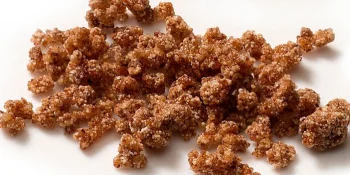


Agglomeration is a particle size enlargement process in which fine powders are combined into larger, structured agglomerates. This improves properties such as flowability, wettability, bulk density and dissolution behaviour.

Menu

KNOWLEDGE HUB
Process technologies for tomorrow.
When to Use Agglomeration in Powder Processing
Apply agglomeration to powders when particle size and bulk behaviour no longer meet process or product requirements. In many powder processing environments, fine particles exhibit limitations such as poor flowability, dust formation or inconsistent dispersion, which directly affect handling, dosing and end-use performance.
Agglomeration modifies these characteristics by enlarging particles while preserving the functional properties of the primary material. The selection of agglomeration as a process step depends on how material behaviour interacts with process conditions and the intended application.
From powder limitations to process requirements
Fine powders often behave unpredictably in industrial systems. Cohesive forces between small particles can lead to unstable flow, making it difficult to achieve consistent feeding or dosing. At the same time, dust formation can create safety concerns and product losses, particularly in chemical and mineral applications.
In addition to handling challenges, product performance can also be affected. Powders that need to dissolve or disperse in liquids may remain on the surface, form lumps or dissolve too slowly, depending on their structure and surface properties.
Agglomeration is typically introduced when these limitations cannot be resolved through handling or equipment adjustments alone, but require modification of the particle structure itself.
Modifying powder behaviour through particle size enlargement
By increasing particle size, agglomeration reduces the influence of inter-particle forces, resulting in more stable and predictable bulk behaviour. Larger particles flow more easily, generate less dust and can be handled more consistently in downstream processes.
At the same time, the internal structure of the agglomerate plays a key role. Porous agglomerates allow liquids to penetrate more easily, improving wettability and dispersibility. This is particularly relevant for applications such as instant food products, where rapid dissolution without lump formation is required.
In multi-component formulations, agglomeration can also stabilise mixtures by binding different particles into composite granules, reducing the risk of segregation during transport and storage.
Positioning agglomeration among particle size enlargement technologies
Agglomeration is one of several methods used to increase particle size, each based on a different physical principle. Technologies such as compaction, extrusion or spray drying produce particles with different densities, structures and functional properties.
Where dense, high-strength particles are required, pressure-based techniques may be preferred. In contrast, agglomeration is typically selected when a more open and porous structure is needed, allowing the powder to retain certain characteristics of the primary particles while improving bulk behaviour.
The choice between these approaches depends on the relationship between particle structure and end-use requirements, rather than particle size alone.
Application-driven use of agglomeration
Agglomeration is applied across a wide range of industries where powder behaviour must be controlled more precisely.
In food processing, it is used to produce instant powders with improved solubility and handling characteristics. In pharmaceutical applications, agglomeration can transform fine powders into more compressible or free-flowing materials. In chemical and mineral processing, it is often applied to reduce dust and improve handling of fine or hazardous materials.
Across these applications, the target particle size typically falls within a range of approximately 100 to 1,500 microns, depending on the required balance between flowability, strength and dispersibility.
From application need to process selection
Selecting agglomeration requires a clear understanding of the relationship between material properties and process objectives. Factors such as particle size distribution, moisture sensitivity, binder interaction and downstream processing requirements all influence whether agglomeration is the appropriate solution.
Because powder behaviour cannot be fully predicted, process development often involves laboratory and pilot-scale testing to validate the approach and determine the optimal process conditions.
Integrating agglomeration into powder processing
Agglomeration is rarely an isolated step. It is typically integrated with upstream mixing and downstream drying and classification to ensure that the final product meets both process and application requirements.
Hosokawa Micron develops agglomeration processes as part of a broader powder processing system, ensuring that particle size enlargement contributes to consistent product quality and reliable industrial performance.
Talk to our experts
Selecting the appropriate agglomeration technology depends on material behaviour, particle properties and process constraints. Hosokawa Micron provides expertise in particle engineering, equipment selection and integrated agglomeration systems for powder processing applications.

Learn more
FAQ – powder agglomeration
What is agglomeration in powder processing?
Why is agglomeration used?
Agglomeration is used to improve powder handling, reduce dust formation, minimise segregation and enhance product performance. It also enables better downstream processing such as conveying, dosing, mixing or compression.
What is the difference between agglomeration and granulation?
Agglomeration and granulation are closely related processes. In many industrial contexts, agglomeration refers to forming porous, structured particles, while granulation often implies more dense and defined granules. The exact definition depends on the application and industry.
How does agglomeration improve powder properties?
By increasing particle size and creating a porous structure, agglomeration improves flow behaviour, reduces dust, enhances wettability and allows faster and more controlled dissolution of powders.
What industries use agglomeration technologies?
Agglomeration is widely used in industries such as food, chemicals, detergents, pharmaceuticals and minerals. Typical applications include instant food powders, fertilisers, water-soluble chemicals and pharmaceutical formulations.
How does the Flexomix agglomeration system work?
The Flexomix system uses high-intensity mixing combined with extremely short residence times to achieve instant agglomeration. Liquid is distributed rapidly and uniformly, resulting in controlled particle growth and a consistent, porous product structure.