

Processing Systems for Side Streams
In the food and feed industries, the valorisation of production side streams is a key strategy to enhance resource efficiency, reduce waste and support sustainable production goals. Process engineers and decision-makers are actively seeking ways to turn these residual streams—often rich in valuable nutrients—into high-quality, value-added products. With advanced processing technologies, side streams that were once discarded as waste or relegated to low-value applications can now become significant sources of additional revenue and support the transition to a circular economy.
Unlock the hidden value in your production side streams
Residual streams from meat, fish, vegetable and fruit processing, as well as from bakeries, breweries and biorefining plants, often contain significant levels of proteins and other functional components. These side streams present real opportunities to develop nutritionally valuable products for both human food and animal feed applications.
The fish and seafood processing industry is a prime example. By-products such as heads, bones, skins, and guts, traditionally seen as waste, can be efficiently valorised into high-quality, nutritious animal-based proteins. These recovered ingredients are ideal for use in premium food products and specialised feed formulations.

Common side streams suitable for valorisation:
✅ Fish and seafood by-products (heads, bones, skins, guts)
✅ Meat processing residues
✅ Vegetable and fruit processing by-products
✅ Side streams from bakeries and breweries
✅ Biorefinery process residues
A typical system for valorising residual streams
An effective valorisation process often follows these key steps:
Grinder > Cooker > Screw Press > Decanter > DMR Flash Dryer
- Grinder: Reduces the size of residual products, for example, by crushing fish bones.
- Cooker: Applies heat to improve material handling and eliminate bacteriological risks further down the process.
- Screw Press: Extracts most of the free liquid (water and fat) from the material.
- Decanter (3-phase): Separates the liquid phase into three streams—water phase, oil phase, and wet press cake (pulp).
- Evaporator (optional): Increases the dry matter content of the water phase, producing evaporated stick water.
- DMR Flash Dryer: Rapidly dries the wet press cake (optionally mixed with stick water) into a high-value, nutritious powder.
Efficient drying of heat-sensitive products
Recovering valuable proteins and functional nutrients from side streams depends on a robust, energy-efficient and cost-effective drying process. While conventional spray drying remains widely used, it is highly energy-intensive and increases operational costs.
Hosokawa Micron’s DMR flash dryer offers a highly efficient and sustainable alternative to spray drying, specifically engineered to preserve product quality while significantly reducing energy consumption. Thanks to its advanced design, the DMR safeguards heat-sensitive components such as aromas, flavours, and proteins, and prevents oxidation. This ensures that the nutritional and functional properties of your ingredients remain fully intact throughout the drying process.
The DMR Flash Dryer enables precise control over critical process parameters—such as mill disc speed, classifier settings, suction fan speed, feed rate, and inlet and outlet temperatures. This precise control allows for careful management of product exposure time in the drying chamber, maintaining optimal product temperatures and ensuring consistent product quality. Our R&D team works closely with you to define the ideal process parameters, ensuring maximum efficiency and product performance.
Key Benefits of the DMR Flash Drying System:
✅ All-in-one process for improved efficiency, ROI, and sustainability
✅ Significant energy savings compared to conventional spray drying
✅ Ideal for heat-sensitive ingredients, preserving product functionality and quality
✅ Compact, integrated design combining drying, milling, and classification
✅ Optimised for producing protein-rich and functional food and feed powders
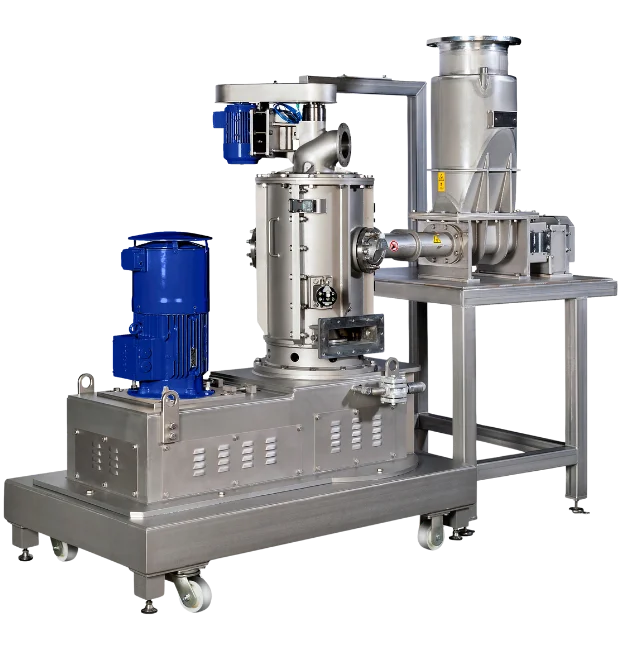
Use case: fish bones
In the case of fish bones, for example, the grinder first reduces particle size, preparing the material for downstream processing. The material is then cooked and strained, and the liquid phase is separated into water, oil and wet press cake (pulp) using a decanter.
- The oil phase can be further processed into purified fish oil, suitable as a flavouring ingredient.
- The water phase (stick water) can be concentrated in an evaporator and mixed with the pulp to feed the drying system.
- Finally, the DMR Flash Mill Dryer can transform the material into a high-protein fish powder, suitable for use in products such as fish burgers and shrimp
This valorisation process is highly efficient and sustainable, leaving no waste material behind. The inputs are fully converted into high-value fish oil and nutritious fish powders, while any remaining water is simply evaporated.
Moreover, the DMR system not only outperforms spray drying in terms of energy consumption but also helps maximise throughput and minimise downtime thanks to its low-maintenance design. This makes it the ideal technology for companies looking to combine sustainable production methods with profitable business opportunities.
Test before you invest
Run trials with your own materials on lab and production-scale equipment at our 2,000 m² Test Centre in the Netherlands. Our experienced process specialists work with you to determine the right process, equipment or system configuration for your application. Each trial is supported by a detailed technical report, helping you select the right solution with confidence.
Learn more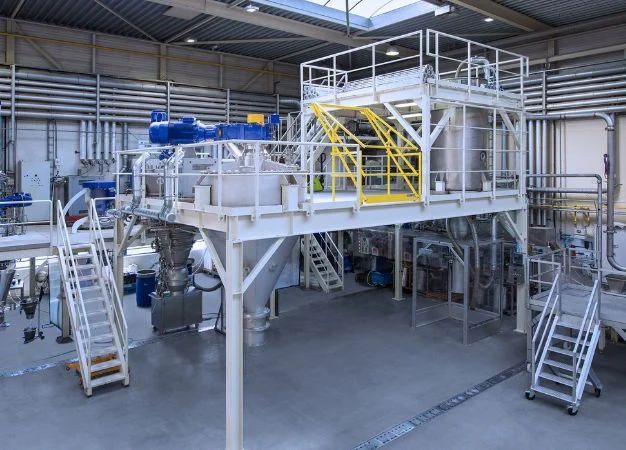
Talk to our experts
Ready to turn your side stream into high-value food or feed ingredients? Contact our team to explore how Hosokawa’s advanced solvent removal technologies can help you improve quality, ensure compliance and support your sustainability goals.

Our process solutions


Sustainable process technologies
Hosokawa Micron B.V. is committed to sustainable and responsible process technology. Our environmental management system is certified to ISO 14001, while our EcoVadis Silver Medal places us among the top 3% of rated companies in the special-purpose machinery industry.
