

Dry Cleaning and Residue Prevention in Mixers
Managing bulk solids residues in mixers used for multiple products can present significant challenges. While wet cleaning methods, such as rinsing with water, may seem straightforward, they introduce moisture into the equipment, leading to contamination risks—particularly the growth of bacteria. Dry cleaning is an ideal solution for eliminating moisture, but it requires careful planning and specific design considerations to be truly effective.
At Hosokawa Micron, with over 85 years of experience in supplying mixers to the market, we have developed innovative dry-cleaning solutions for powder processing systems. The core principle behind dry cleaning is to prevent moisture from entering the equipment, thereby minimising the risk of bacterial growth and other contaminants.
Effective dry cleaning through process optimisation
 Effective dry cleaning can be significantly enhanced by careful process design, considering factors such as vessel selection, material transfer steps, and the placement and number of liquid additions. Equally important is the design of the mixer itself. Key features that enhance dry cleaning in mixers include:
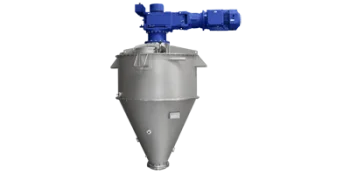
- Conical mixer design: By utilising gravity to empty the mixer, the inclined surfaces reduce opportunities for powder to settle and form residues.
- Central bottom outlet: A bottom outlet without restrictions enables complete discharge of the mixer.
- Seamless vessel construction: Mixer vessels made from a single piece with smooth surfaces prevent residue buildup in seams.
- Open screw flights: In conical screw mixers, the mixing screw can be designed with open flights to reduce residue buildup on the screw.
Identifying and cleaning deposit zones in screw mixers
Despite design optimisations, some product residues will inevitably remain in a mixer after processing. Understanding where these residues accumulate is essential for selecting the right cleaning approach. Typically, there are three zones where deposits form in a screw mixer:
- Above the product level: Surfaces in this zone mainly experience dust deposition during filling, mixing, and emptying. As the residue here is usually loose, it can often be easily removed using compressed air.
- Below the product level: Surfaces in this zone have more significant contact with the product. Due to gravity and the constant movement of powder particles, residues tend to adhere more strongly here. Any liquids in the mixture will further increase adherence to the vessel walls. In many cases, a dry cloth may still be sufficient for cleaning this area.
- On the mixing screw: The toughest layers of residue typically form on the mixing screw, especially underneath the blades. Removing these residues often requires more forceful cleaning methods, such as brushes or other cleaning tools.
Three solutions for dry cleaning screw mixers
To address these challenges, the specialists at Hosokawa Micron recommend three solutions that significantly enhance the dry cleaning process for conical screw mixers:
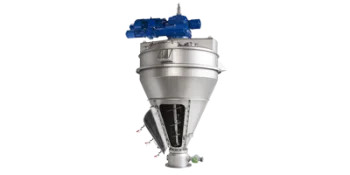
 Inspection door: An operator-sized inspection door in the vessel wall provides easy access to all surfaces that require cleaning. Particular attention should be given to the welds connecting the screw flights to the shaft, as well as the lower surface of the screw. The large door ensures these critical areas are accessible for thorough cleaning. When closed, a silicone O-ring, combined with several quick-release clamps, ensures a tight, secure seal. To prioritise safety, a built-in safety switch prevents the door from opening while the screw is rotating. Additionally, the door is designed to be flush with the vessel wall when closed, ensuring a smooth interior surface.
- Semi-domed cover: To further enhance cleanability, many customers opt for a semi-domed cover welded to the cone. This design eliminates crevices and offers smooth, rounded surfaces where residue is less likely to build up, thereby reducing the risk of contamination.
- ISEM outlet valve: Another feature that facilitates dry cleaning is Hosokawa's ISEM ball segment valve in the outlet opening. Its rounded interior minimises the risk of material deposits. Additionally, an inspection port allows for easy removal of any residues.
Conclusion
Dry cleaning bulk residues in powder and solids mixers is essential for maintaining hygiene and reducing contamination risks, especially when using one machine for multiple products. With optimised mixer designs and smart features such as inspection doors, semi-domed covers, and the ISEM outlet valve, Hosokawa's conical screw mixers offer effective dry cleaning solutions. By considering both the nature of the deposits and the mixer's design, operators can significantly reduce cleaning times and improve overall production efficiency.
Talk to our experts
Let our process specialists help you identify the most suitable solution for your materials, process requirements and production goals.

Related content



Sustainable process technologies
Hosokawa Micron B.V. is committed to sustainable and responsible process technology. Our environmental management system is certified to ISO 14001, while our EcoVadis Silver Medal places us among the top 3% of rated companies in the special-purpose machinery industry.
