Cement additive processing involves powder processing steps such as mixing, drying, agglomeration and materials handling to achieve consistent flow behaviour, additive distribution and product performance in dry mortar and cement-based formulations.

Menu

MINERALS & METALS
Process technologies for tomorrow.
Cement additive processing and dry mortar mixing systems
Produce cement additives and dry mortar formulations with controlled powder processing technologies. Cement-based products such as dry mortar, premixes and functional additives require consistent particle size distribution, reliable flow behaviour and homogeneous additive dispersion to ensure predictable performance in construction applications.
Cement additive processing typically involves multiple powder processing steps, including mixing, drying, agglomeration and materials handling. These unit operations determine powder properties such as flowability, particle size distribution and additive dispersion. For cement additive processing, Hosokawa Micron provides technologies covering these unit operations, supporting reliable, scalable and energy-efficient production of dry mortar and cement-based formulations.
Mixing and blending of cement additives
Dry mortar and cement additive formulations require accurate and homogeneous blending of base materials such as cement, lime, fillers and performance-enhancing additives. Variations in raw material properties, bulk density and particle size distribution can directly affect dosing accuracy, product consistency and final application performance.
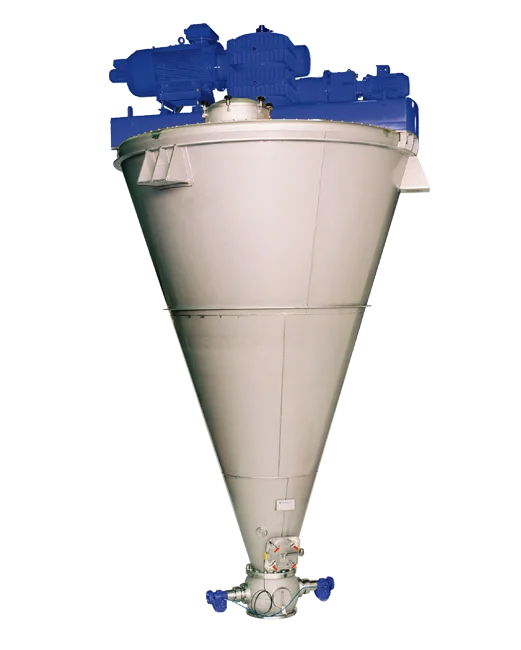
For cement additive processing, Hosokawa Micron provides mixing technologies such as the Nauta® conical screw mixer by Hosokawa Micron, designed for gentle, low-shear blending of powders with different bulk densities and particle characteristics. The convective mixing principle ensures homogeneous distribution of additives while minimising segregation and product degradation.
For applications requiring faster mixing cycles or higher shear input, the conical paddle mixer (CPM) by Hosokawa Micron provides efficient and accurate blending across a wide range of batch sizes. This enables flexible production of dry mortar formulations with consistent quality.
This is particularly relevant for low-dosage additives where uniform distribution is critical for product performance.
Drying technologies for cement additives
Moisture content in fillers and additives can influence powder flow behaviour, storage stability and dosing accuracy in dry mortar production. Drying technologies must therefore be selected based on feed moisture, required throughput and energy efficiency.
For cement additive processing, Hosokawa Micron provides drying technologies such as the DMR flash dryer by Hosokawa Micron, which enables rapid moisture removal in a continuous process while maintaining powder quality. These systems are particularly suitable for fine materials and additives requiring controlled drying conditions.
Where gentle processing or multifunctional operation is required, Hosokawa Micron vacuum dryers can be applied to combine drying with additional process steps such as heating or cooling, depending on the material requirements.

Agglomeration and powder design
In dry mortar and cement additive applications, powder behaviour such as flowability, dust formation and dispersibility can be critical for both processing and end-use performance. Agglomeration and particle design technologies are often applied to optimise these properties.
For cement additive processing, the Flexomix continuous agglomeration system by Hosokawa Micron enables controlled particle growth and densification. This can improve powder flow, reduce dust emissions and enhance handling and dosing characteristics in production and on-site application.
Agglomeration can also support the production of free-flowing additive systems with improved storage stability and reduced segregation.

Integrated processing systems for dry mortar and cement additives
Cement additive production typically combines multiple unit operations, including mixing, drying, agglomeration and materials handling. Integrating these steps into a well-designed process system is essential to ensure consistent product quality and efficient plant operation.
For cement additive processing, Hosokawa Micron provides integrated powder processing systems that combine these technologies into a single engineered solution. Systems are designed based on material characteristics, required throughput and product specifications, supporting reliable and scalable production.
Typical cement additives and materials processed
- Dry mortar formulations
- Cement additives
- Lime and fillers
- Fly ash
- Limestone powders
- Functional construction additives
Test before you invest
Run trials with your own materials on lab and production-scale equipment at our 2,000 m² Test Centre in the Netherlands. Our experienced process specialists work with you to determine the right process, equipment or system configuration for your application. Each trial is supported by a detailed technical report, helping you select the right solution with confidence.
Learn more
Talk to our experts
Let our process specialists help you develop the optimal solution for your cement additives or dry mortar processing – from the first trial in our test centre to a full-scale industrial production system.

FAQ – processing cement additives
What is cement additive processing?
Which mixer is suitable for dry mortar and cement additives?
The appropriate mixer depends on the formulation, bulk density differences and required mixing intensity. For gentle, accurate blending, the Nauta® conical screw mixer by Hosokawa Micron is a suitable option, while the conical paddle mixer (CPM) by Hosokawa Micron can be applied where faster mixing cycles or higher shear input are required.
Why is drying important in cement additive processing?
Drying helps control moisture content in fillers and additives, which affects powder flow behaviour, storage stability and dosing accuracy. Technologies such as the DMR flash dryer by Hosokawa Micron support continuous moisture removal while maintaining powder quality.
Our process solutions



Sustainable process technologies
Hosokawa Micron B.V. is committed to sustainable and responsible process technology. Our environmental management system is certified to ISO 14001, while our EcoVadis Silver Medal places us among the top 3% of rated companies in the special-purpose machinery industry.
