

Plastic Waste Treatment and Recycling
Process technologies for polymer recycling increasingly focus on converting plastic waste streams into reusable raw materials. Depending on the composition of the waste stream, recycling routes may include mechanical recycling, dissolution processes or pyrolysis-based recovery. Across these processes, mixing, drying, agglomeration, size reduction, and solids handling technologies influence product quality, process stability and operational efficiency.
Within the Hosokawa Micron Group, powder processing expertise supports polymer recycling applications involving powders, granules, flakes and recovered solids. Mixing, drying, size reduction and agglomeration technologies are applied in polymer recovery, additive production, solvent removal and recovered carbon black processing, helping manufacturers improve material reuse and reduce waste streams.
Post consumer recycling (PCR)
Global plastic production continues to increase, placing greater emphasis on recycling and circular material use. Polymer recycling processes aim to recover valuable materials from post-industrial and post-consumer plastic waste while reducing disposal volumes and raw material consumption.
Mechanical recycling remains the most common recycling route and typically involves sorting, washing, shredding, drying, remelting and reforming plastic waste while preserving the original polymer structure. Additional recycling routes, including dissolution and pyrolysis, are increasingly applied for mixed, contaminated or more complex waste streams.
Post-consumer recycling (PCR) and post-industrial recycling (PIR) streams create different processing requirements depending on contamination levels, polymer composition and material consistency. Household packaging waste often contains labels, inks, oils, food residues, metals or mineral contaminants that complicate downstream washing and separation processes.
Polymer recycling and plastic waste recovery
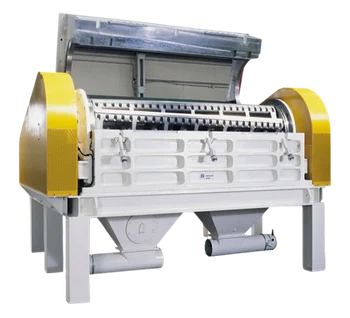
Recycling technologies from Hosokawa Alpine support the preparation of post-consumer plastic waste prior to washing, separation and material recovery. Size reduction systems such as the Hosokawa Alpine Rotoplex granulator are applied for wet or dry shredding of mixed plastic waste streams, producing consistent flakes with limited fines generation and controlled particle geometry. Accurate cutting behaviour and reduced dust formation can improve washing efficiency, downstream drying performance and the quality of recovered recyclates.
Efficient pre-processing and short process chains can reduce energy consumption, maintenance requirements and operational complexity within polymer recycling plants.
Different recycling routes generate flakes, granules and recovered solids with varying flow behaviour and moisture characteristics. Powder processing technologies therefore play an important role in stabilising downstream handling, drying and material recovery operations.
Mixing technologies for polymer recycling
Polymer recycling processes often require accurate mixing of powders, additives and recycled materials with different bulk densities, particle sizes and thermal sensitivities. Achieving homogeneous mixing without excessive heat generation is particularly important for temperature-sensitive additives and polymer compounds.
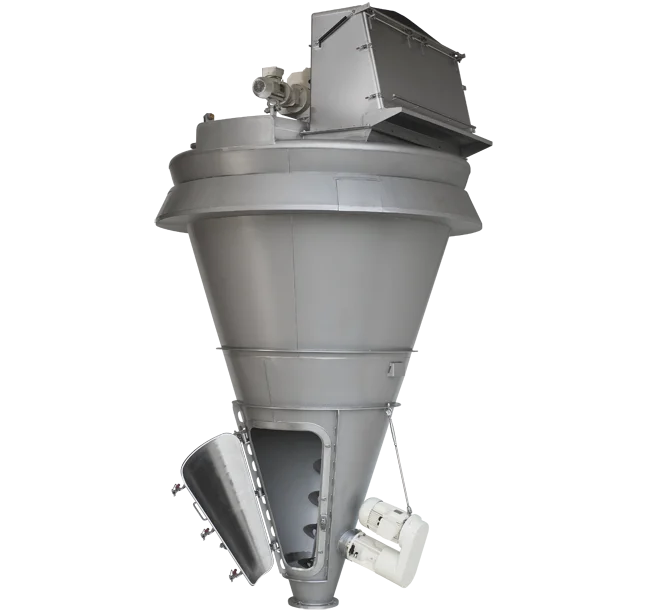
The Nauta® conical screw mixer by Hosokawa Micron is widely applied for gentle batch mixing of polymer powders and additives. Its convective mixing principle combines efficient homogenisation with relatively low heat input, making the technology suitable for sensitive polymer formulations and additive masterbatches.
In polymer compounding and recycling applications, mixing technologies may also be integrated with dosing, extrusion and conveying systems to maintain stable feeding conditions and repeatable product quality. Powder flow behaviour and bulk density variations can strongly influence downstream extrusion and pelletising stability.
Vacuum drying in polymer dissolution processes
Plastic-rich waste streams with high polymer content can be processed through dissolution-based recycling routes. In these processes, solvents dissolve the polymer fraction, allowing contaminants to be mechanically separated before the polymer is recovered through solvent evaporation and drying.
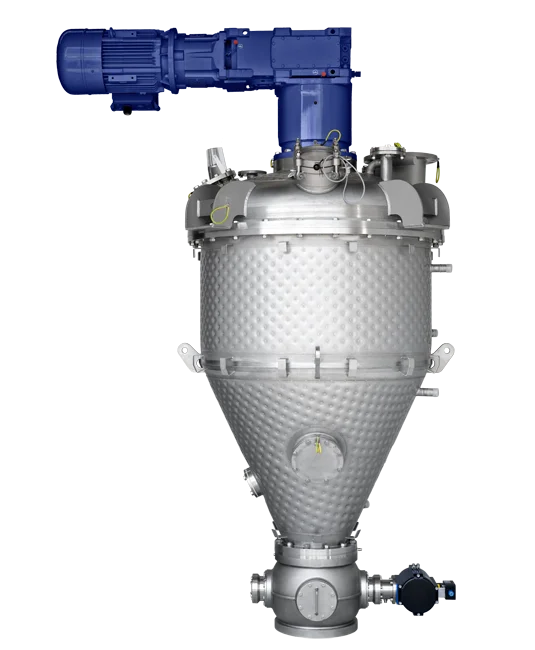
Vacuum drying technologies are commonly applied where controlled low-temperature drying and solvent recovery are required. The Hosokawa Micron conical screw dryer and conical paddle dryer support efficient solvent removal under reduced pressure while limiting thermal degradation of temperature-sensitive polymers.
Drying performance depends strongly on solvent properties, residual moisture levels, product viscosity and heat transfer behaviour during the transition to dry solids. Controlled drying conditions help maintain product quality while supporting stable downstream extrusion and pelletising operations.
For materials with fluctuating moisture content or sticky intermediate phases, controlled drying conditions are particularly important to prevent product build-up, inconsistent discharge behaviour and downstream handling instability.
Pyrolysis and recovered carbon black processing
Pyrolysis processes convert mixed or contaminated plastic waste streams into oils, gases and solid residues through thermal treatment in the absence of oxygen. Similar recovery technologies are also applied in tyre recycling to produce recovered carbon black (rCB). Following pyrolysis, recovered solids often require further processing before reuse. Residual materials may contain mineral fractions such as calcium carbonate or titanium dioxide, creating additional challenges related to particle size distribution, powder flow behaviour and product consistency.
The Hosokawa Micron Group supplies powder processing technologies for grinding, drying, agglomeration and powder handling within recovered carbon black and polymer recovery applications. Agglomeration and pelletising technologies can improve bulk density, reduce dust formation and stabilise downstream handling behaviour for recovered powder materials.
Process development for recycling applications
Polymer recycling processes involve strong variations in feed composition, contamination levels, particle size and residual moisture content. Pilot-scale process development therefore plays an important role in validating drying behaviour, mixing performance and downstream powder handling characteristics before implementation.
The Hosokawa Micron Test Centre in the Netherlands supports process development for polymer recycling, recovered carbon black and powder handling applications. Test programmes can evaluate parameters such as particle size distribution, residual solvent content, powder flow behaviour, bulk density and drying performance under realistic process conditions.
Learn more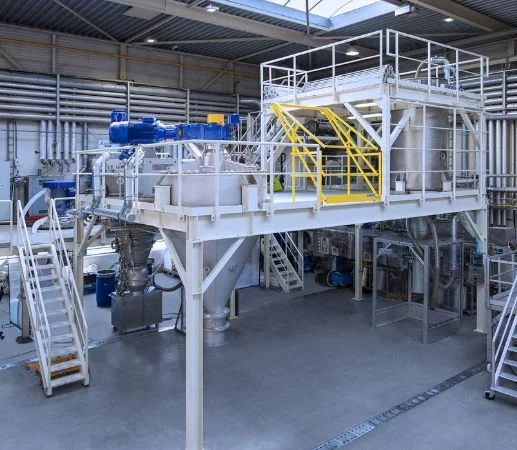
Talk to our experts
Our process specialists support polymer recycling and powder processing applications from pilot-scale testing to industrial production systems.

Read next




Sustainable process technologies
Hosokawa Micron B.V. is committed to sustainable and responsible process technology. Our environmental management system is certified to ISO 14001, while our EcoVadis Silver Medal places us among the top 3% of rated companies in the special-purpose machinery industry.
