

Mixing Systems for Pharmaceutical Powders
Pharmaceutical powder mixing requires precise control of blend uniformity, segregation risk, containment and cleanability. Hosokawa Micron develops mixing systems for APIs and excipients, from low-shear blending in the Nauta® conical screw mixer to medium- and high-shear processing with the Conical Paddle Mixer and Cyclomix. Depending on the process, systems can incorporate feeding, dosing, liquid addition, contained charging and discharge, CIP cleaning and SIP sterilisation.
Applications range from premixes and low-dose formulations to direct compression and dry powder inhalers. In tablet production, mixing is often followed by wet or dry granulation, while suitable formulations can be processed by direct compression. The appropriate mixer and process sequence depend on powder cohesion, differences in bulk density and particle size, the required mixing energy and relevant safety and regulatory requirements. Trials at the Test Centre help validate the process choice and support scale-up from R&D to production.
Wet and dry granulation
In tablet manufacturing, achieving a uniform blend is only part of the challenge. The formulation must also provide suitable flowability and compressibility, while maintaining content uniformity during discharge, transfer and feeding into the tablet press. Differences in particle size, bulk density and cohesion between APIs and excipients can increase the risk of segregation.
Wet granulation can improve flowability and compressibility, but typically involves additional steps such as liquid addition, granulation, drying and sizing. Dry granulation avoids liquid addition and may be preferable for moisture-sensitive formulations, although the formation of fines and the properties of the resulting granules must be considered.
Both approaches have their place, depending on the formulation and downstream processing requirements.
Advantages of direct compression
Where the formulation is suitable, direct compression allows a dry powder blend to be compressed into tablets without a separate granulation step. This can simplify production, reduce material handling and potentially save time and energy. However, direct compression requires adequate powder flowability, compressibility and blend stability throughout the process. These properties depend on the formulation, ingredient characteristics and equipment configuration.
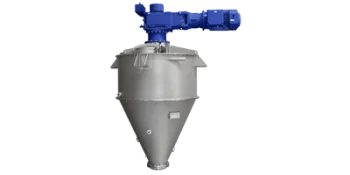
The Nauta® conical screw mixer provides gentle, low-shear blending of pharmaceutical powders. Its flexible working volume and ability to accommodate multistage ingredient addition make it suitable for a wide range of blending operations, including the preparation of low-dose formulations.
Depending on the formulation and plant layout, the mixer can be integrated directly with downstream equipment to reduce transfer steps and help minimise segregation risks. Whether granulation can be omitted must be established through formulation studies, process trials and validation.

Total mixing solution
At Hosokawa Micron, rather than just supplying machines, we like to take a broader approach to designing a total mixing solution, including pre- and post-processes. We always consider four aspects: how the powder is fed into the mixer, what happens inside the vessel, how the powder is discharged, and how the equipment is cleaned. For example, for the charging and discharging of toxic materials, we can use or develop customised container docking systems including lift systems or split butterfly valves.
During the mixing process, we account for any ingredients the customer may need to add and how they will affect the process. This includes liquids, which can even be heated or cooled during mixing if necessary. Post-processing equipment such as de-agglomerators, sieves and cone mills can be integrated where required, for example to break down agglomerates or achieve the desired particle size distribution.
The conical vessel design and top-driven agitator of the Nauta® conical screw mixer help minimise the risk of segregation during discharge. Depending on the plant layout, the mixer can be positioned directly above a tablet press, reducing intermediate handling and transfer steps. This configuration can help maintain blend uniformity throughout the process, subject to the characteristics of the formulation and the downstream equipment.
Cleaning
Cleaning is a critical consideration in pharmaceutical powder processing, particularly when handling potent or hazardous materials. Hosokawa Micron offers integrated cleaning-in-place (CIP) and sterilisation-in-place (SIP) solutions, including the associated control systems. Depending on the system configuration, dedicated CIP/SIP skids can remain connected, reducing manual handling and helping minimise the risks of cross-contamination and operator exposure.
Our systems are designed to meet applicable regulatory requirements and customer-specific specifications, with supporting documentation to facilitate equipment qualification and process validation.

Small-scale practical trials
Early involvement in pharmaceutical formulation development can help identify the most suitable mixing technology and process configuration. Since every formulation presents different challenges, factors such as blend uniformity, flowability, segregation risk and downstream processing requirements must be carefully evaluated.
For example, preparing premixes and adding excipients within the same Nauta® conical screw mixer may offer advantages over separate mixing steps, depending on the formulation. At our test centre in the Netherlands, customers can explore such possibilities through practical trials using their own materials. These trials provide valuable insights into mixing performance and help determine suitable process parameters and equipment configurations.
For suitable formulations, direct compression may simplify manufacturing and reduce processing costs. This can also be relevant when optimising existing products or production processes, provided that the necessary formulation studies and validation requirements are taken into account.

Long-standing experience
Hosokawa Micron has extensive experience in developing scalable mixing technologies for the pharmaceutical industry, from R&D to full-scale production. In addition to the Nauta® conical screw mixer for gentle, low-shear blending, we offer the conical paddle mixer (CPM) for medium-shear mixing and the Cyclomix for high-shear processing of cohesive powders, including those used in dry powder inhaler (DPI) formulations.
The required mixing energy depends on a number of factors such as powder characteristics (including material cohesion and particle size), end product properties, and process, safety and system requirements. Hosokawa Micron, with its extensive experience and proprietary technology, provides tailor-made mixing solutions for each customer's needs.

Talk to our experts
Let our process specialists help you identify the most suitable solution for your materials, process requirements and production goals.

Our process solutions




Sustainable process technologies
Hosokawa Micron B.V. is committed to sustainable and responsible process technology. Our environmental management system is certified to ISO 14001, while our EcoVadis Silver Medal places us among the top 3% of rated companies in the special-purpose machinery industry.
