

How to Choose the Right Industrial Dryer
Selecting the right industrial dryer for powders and bulk solids is a complex process decision. Multiple drying technologies can often achieve similar final moisture levels, especially when process parameters such as temperature, residence time and throughput are adjusted. The challenge lies in identifying the drying technology that delivers consistent product quality under real operating conditions.
For industrial powder processing, dryer selection depends on the interaction between material behaviour, process requirements and desired product characteristics. Hosokawa Micron supports this selection through in-depth process knowledge, industrial drying technologies for powders and bulk solids, and system integration expertise.
Defining the ideal drying process
In practical terms, the ideal drying system is not defined by a single parameter, but by a combination of performance characteristics. An optimal industrial dryer:
- delivers consistent final moisture content and controlled particle size distribution
- maintains product quality under varying feed conditions
- handles fluctuations in moisture content and feed rate without process instability
- enables reliable feeding and discharge of material
- operates with predictable energy consumption per tonne of dried product
- requires limited maintenance and integrates efficiently into the production environment
In addition, the drying process should be stable, controllable and suitable for automation, with minimal operator intervention.
In practice, however, trade-offs between these factors are unavoidable.
Energy consumption and process efficiency
Energy consumption is a key consideration in drying technology selection. Thermal drying processes are inherently energy-intensive compared to mechanical dewatering methods. For this reason, it is often beneficial to remove as much moisture as possible mechanically before thermal drying is applied.
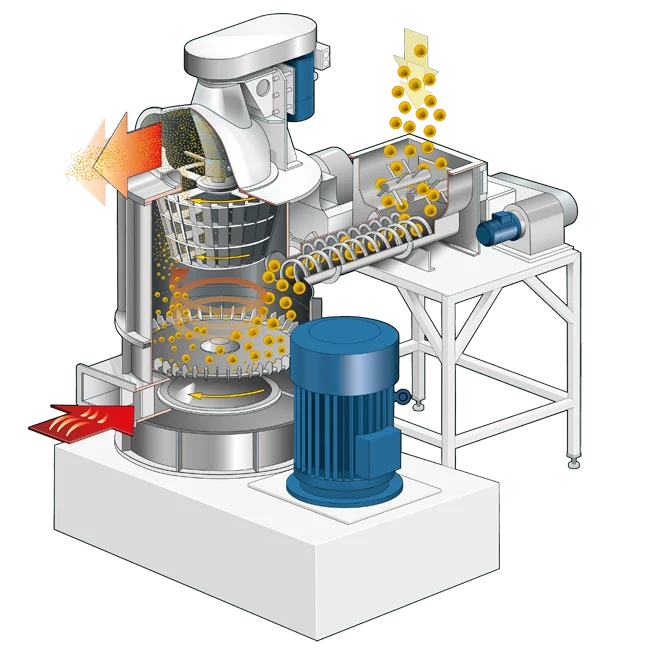
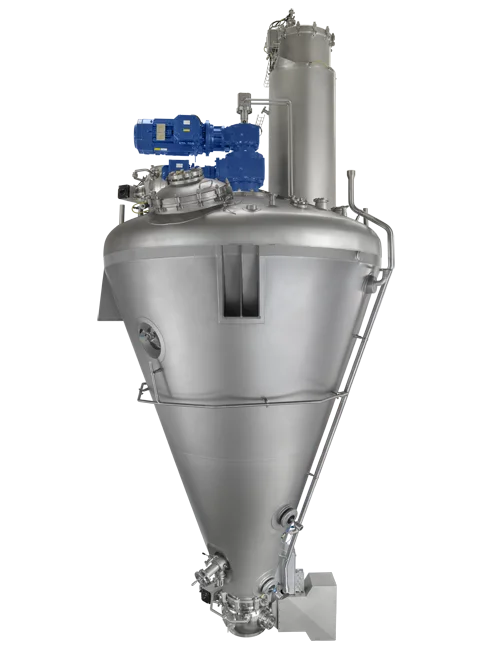
However, process constraints can influence technology selection. For example, in flash drying systems, a minimum moisture level may be required to ensure stable conveying and heat transfer. In contrast, vacuum dryers enable drying at lower temperatures, reducing thermal load on sensitive materials.
As a result, energy efficiency cannot be evaluated in isolation, but must be considered in relation to overall process stability and product quality.
Material properties and drying behaviour
The physical and thermal properties of the material are central to dryer selection.
Key material-related factors include:
- particle size and particle size distribution
- moisture content and moisture binding (free vs bound moisture)
- flow behaviour and tendency to agglomerate or become sticky
- thermal sensitivity and risk of degradation
- bulk density and solids concentration
- toxicity or explosion risk (ATEX considerations)
In many drying processes, the material undergoes significant changes in consistency. A liquid feed may transform into a paste, sticky phase or powder during drying. The selected drying technology must be capable of handling these transitions without fouling, build-up or process interruptions.
For heat-sensitive materials, such as certain food or pharmaceutical products, low-temperature drying technologies such as vacuum drying or freeze drying may be required.
Process conditions and system integration
Dryer selection is also influenced by process-related requirements and system configuration.
Key process considerations include:
- batch versus continuous operation
- required throughput (kg/h or t/h)
- evaporation capacity (kg water/h)
- residence time and residence time distribution
- integration with upstream and downstream unit operations
Batch dryers offer greater control over residence time and are often better suited to handling variations in feed properties.
Continuous dryers, on the other hand, provide higher capacity relative to equipment size and are generally easier to integrate into automated production lines. Continuous drying technologies such as flash dryers are often selected for high-throughput applications, while vacuum dryers are typically preferred for batch processes requiring precise temperature control.
The interaction with upstream processes (such as dewatering or feeding) and downstream operations (such as milling, classification or packaging) plays a critical role in determining the most suitable drying solution.
Product requirements and quality control
Product quality remains the leading factor in drying technology selection. In addition to final moisture content, relevant product characteristics include:
- particle size and particle size distribution
- particle strength and breakage behaviour
- bulk density and flowability
- solubility or dispersibility
- dust formation and surface properties
Drying conditions directly influence these properties. For example, high thermal input or excessive residence time can lead to particle degradation, while insufficient drying may result in poor storage stability or downstream handling issues.
Selecting the appropriate drying technology therefore requires careful alignment between process conditions and product specifications.
Drying kinetics and process phases
Drying processes typically follow a characteristic pattern consisting of two main phases.
Constant rate drying
In the initial phase, excess free moisture is present on the particle surface. The drying rate is primarily determined by heat input, and remains relatively constant as long as process conditions are stable. During this phase, particle temperature remains close to the wet-bulb temperature. Technologies such as flash dryers are designed to maximise heat and mass transfer during this phase.
Falling rate drying
Once surface moisture is removed, moisture transport becomes controlled by internal diffusion and capillary forces. The drying rate decreases, and particle temperature increases. Removing bound moisture requires significantly more energy and time. Technologies such as vacuum dryers are often applied when controlled low-temperature drying is required during this stage. Understanding these drying phases is essential for selecting the appropriate drying technology and defining residence time requirements.
Dryer selection as an engineering decision
Selecting an industrial dryer is not a matter of comparing individual equipment specifications. It is the result of balancing material behaviour, process conditions and product requirements within the constraints of energy consumption, operability and system integration. For this reason, dryer selection is often described as an engineering discipline requiring both process knowledge and practical experience.
Hosokawa Micron supports this process through pilot-scale testing, process development and the design of integrated drying systems for powders and bulk solids.
Talk to our experts
Let our process specialists help you develop the optimal drying solution based on your material behaviour, process requirements and product specifications.

Read next


Sustainable process technologies
Hosokawa Micron B.V. is committed to sustainable and responsible process technology. Our environmental management system is certified to ISO 14001, while our EcoVadis Silver Medal places us among the top 3% of rated companies in the special-purpose machinery industry.
