

Top 10 Tips for Choosing the Right Powder Mixer
Choosing the right powder mixing equipment is critical for consistent product quality, production efficiency, and regulatory compliance. Whether you're processing fine powders, cohesive materials, or free-flowing granules, your mixer must match your material properties and production goals. Here are 10 essential tips from Hosokawa Micron, a global leader in industrial powder mixers, to help you select the most efficient and reliable solution.
| 1. | Define your mixing goals Clarify whether your process requires homogenising, coating, agglomerating, or deagglomerating powders. Each function may demand a different mixing principle—such as low-shear for gentle blending or high-shear for aggressive processing. |
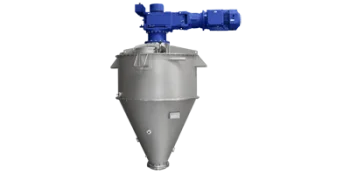
| 2. | Understand powder characteristics Consider bulk density, particle size, flowability, hygroscopicity, and electrostatic behaviour. These properties impact mixer choice, such as a conical screw mixer or a ribbon screw mixer. |
| 3. | Choose between batch and continuous mixing • Batch mixers like the Nauta® conical screw mixer are ideal for flexibility and accuracy. • Continuous mixers are suited for high-throughput, uniform feeding applications. Match the mixer to your production flow and scaling strategy. |
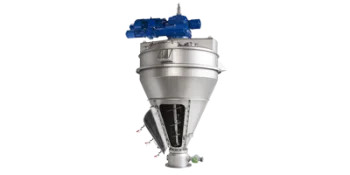
| 4. | Consider mixing time and energy consumption Look for an energy-efficient mixing solution that minimises residence time without compromising blend uniformity. The Vitomix ribbon screw mixer is known for fast cycle times with low energy input. |
| 5. | Check for scale-up support Does the supplier offer process trials or lab-scale models? Hosokawa Micron’s Test Centre allows you to validate mixer performance before committing to full-scale investment. |
| 6. | Think hygienic design and cleanability Especially for food, pharma, or feed applications, the mixer should support easy cleaning, have a seamless vessel, and comply with hygiene regulations. Features like cantilevered shafts or side-access doors simplify maintenance. |
| 7. | Assess component handling capabilities Minor ingredients or micro-components must be evenly distributed. Mixers like the Conical Paddle Mixer offer precise mixing of materials with wide bulk density ranges. |
| 8. | Evaluate discharge and segregation risk Uniform discharge without segregation is key. Look for designs with central bottom outlets and smooth flow paths to maintain blend integrity at every step. |
| 9. | Factor in footprint and integration Make sure the mixer fits your layout and interfaces well with upstream/downstream equipment. Hosokawa offers compact designs with high output-to-size ratios. |
| 10. | Work with a trusted partner Choose a supplier with a proven track record, engineering support, and global service capabilities. Hosokawa Micron combines over 100 years of experience with customised, scalable powder mixing solutions. |
By focusing on these ten aspects, you’ll be better equipped to choose a mixer that meets your production needs, enhances efficiency, and aligns with your operational goals.
Talk to our experts
Need help to find the right mixer? Our engineers are here to help you select or design a mixer that ensures optimal product quality, process efficiency, and regulatory compliance.

Related Content




Sustainable process technologies
Hosokawa Micron B.V. is committed to sustainable and responsible process technology. Our environmental management system is certified to ISO 14001, while our EcoVadis Silver Medal places us among the top 3% of rated companies in the special-purpose machinery industry.
