
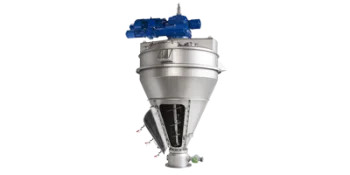

Low-shear batch mixing is a gentle mixing process in which powders or bulk solids are blended with limited mechanical energy. It is typically used for free-flowing, fragile or heat-sensitive materials.

Menu

KNOWLEDGE HUB
Process technologies for tomorrow.
Choosing a Mixer for Low-Shear Batch Mixing
Select a low-shear batch mixer by starting with the material, not the machine. For free-flowing, fragile or heat-sensitive powders and bulk solids, the mixing principle must provide the required blend uniformity while limiting unnecessary shear, heat generation and mechanical stress during processing.
This article explains how material behaviour influences low-shear batch mixing and compares three common mixer types: conical screw mixers, tumble mixers and ribbon mixers. It focuses on free-flowing materials, where segregation risk, filling behaviour, discharge performance and particle integrity often determine mixer selection.
Matching shear level to material behaviour
Selecting a bulk solids batch mixer requires an assessment of the complete process. Recipe composition, quality requirements, batch size, mixing time, material characteristics, filling method and discharge behaviour all influence the mixer type and operating window required to achieve consistent blend quality.
A key selection factor is whether the material is free-flowing or cohesive. Batch mixers are commonly categorised by the amount of shear they apply during mixing. As a general rule, cohesive materials require more mixing energy to overcome interparticle forces, while free-flowing materials can often be blended with lower shear.

Selecting a batch mixer
Low-shear mixing is a relatively ordered process. The mixer operates at low speed and the particles move through the vessel in controlled flow patterns. Mid-shear and high-shear mixing apply more energy and may be required for cohesive powders, poorly dispersible ingredients or materials that need de-agglomeration.
Low-shear mixing is often suitable for free-flowing, fragile or heat-sensitive materials, provided the blend can be homogenised without intensive dispersion or de-agglomeration.
Characteristics of free-flowing materials
Free-flowing materials generally have low interparticle friction and move readily under gravity. They often have relatively low moisture content and particles with a low aspect ratio. Rounded or compact particles tend to flow more easily than elongated or fibrous particles, which may interlock and resist movement.
Particle size also influences flow behaviour. Free-flowing materials may have particle sizes above approximately 75 µm, although actual flow behaviour depends on particle shape, density, moisture content, surface properties and electrostatic effects.
The angle of repose can provide a useful indication of flow behaviour. This is the angle formed when material is poured onto a flat surface. A steeper pile usually indicates higher cohesiveness or resistance to flow, while a flatter pile indicates easier flow.
For mixer selection, angle of repose should not be assessed in isolation. Particle size distribution, bulk density, segregation tendency, friability and discharge behaviour are also important when selecting a low-shear batch mixer.
Segregation risk in free-flowing materials
Free-flowing materials are often easy to move, but not always easy to keep homogeneous. When ingredients differ in particle size, density, shape or mobility, the blend may segregate during filling, mixing, discharge, transfer or packaging.

Types of segregation
- Vibration segregation can occur when a vessel or downstream system is exposed to vibration. Coarser or lighter particles may migrate within the batch, changing the local composition.
- Percolation segregation occurs when finer particles move through the voids between larger particles. This can concentrate fines in one part of the batch and coarser particles in another.
- Transportation segregation can occur when material falls from a chute, spout or conveying line. Larger or denser particles may travel further than finer particles, creating uneven distribution during filling or transfer.
Segregation is particularly relevant in low-shear mixing because a gentle process will not always correct poor filling, uncontrolled discharge or unstable downstream transfer. In some cases, the mixer can produce a uniform blend, but the material may segregate immediately afterwards.
Low-shear mixing modes: diffusion and convection
Low-shear batch mixers commonly rely on convection, diffusion or a combination of both. In convection mixing, defined flow patterns move material through the vessel. Conical screw mixers and ribbon mixers use convective movement to transport material from one zone to another. In diffusion mixing, particles redistribute gradually, often assisted by gravity. Tumble mixers are typical diffusion mixers and can work well for simple, non-segregative blends with similar particle properties.
Convection mixing provides more active material movement, but mixer geometry, filling level, discharge design and seal arrangement become more important. Diffusion mixing is mechanically simple, but it has limitations. If ingredients differ significantly in particle size or bulk density, the achievable homogeneity may be limited and over-mixing can cause demixing.
Low-shear mixer types
For low-shear mixing of free-flowing materials, three common mixer types are considered here:
- conical screw mixers
- ribbon mixers
- tumble mixers
Each type can be suitable depending on material behaviour, batch size, segregation risk, installation constraints and discharge requirements.
Conical screw mixer
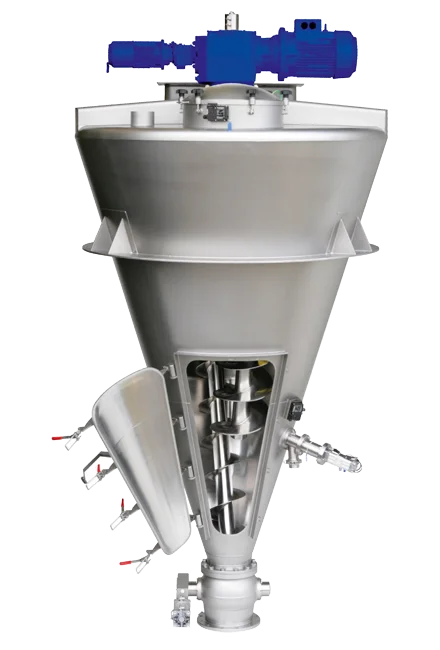
A conical screw mixer is a convective mixer with a screw that rotates and orbits inside a stationary conical vessel. The screw lifts material upwards while gravity returns it through the cone, creating continuous circulation with relatively low shear.
Material is usually filled below the screw orbit arm to allow free movement around the vessel. The conical geometry supports discharge through the bottom outlet, provided the material has suitable flow behaviour.
Conical screw mixer advantages
Conical screw mixers are often selected for gentle convective mixing of free-flowing, fragile or segregation-sensitive powders. The low mixing intensity can help protect particle structure while still supporting blend uniformity.
The conical vessel shape supports discharge through the bottom outlet, which can reduce product retention compared with mixer designs where material must be actively moved from corners or trough sections. Depending on the design, the screw may be cantilevered, avoiding bearings and seals below the material level.
Conical screw mixers can also be suitable for large batch volumes, depending on the product, vessel size and mechanical design.
Conical screw mixer limitations
Conical screw mixers are generally taller than many horizontal mixer designs, which can be a constraint in facilities with limited installation height.
Cohesive or sticky materials may adhere to the screw or vessel wall. This can increase cleaning requirements or create carryover risk between batches. For very large mixers, additional mechanical support may be required, which can influence seal arrangement and product contact design.
Ribbon mixer
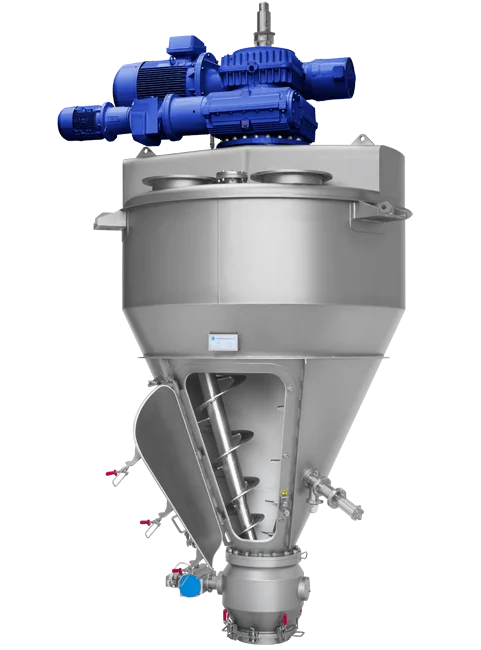
A ribbon mixer is a convective mixer with a rotating ribbon or screw element inside a stationary trough. The mixing element moves material radially and axially, creating circulation patterns through the vessel.
Ribbon mixers are available in different configurations and can be adapted to specific applications. Options may include single or twin shafts, modified ribbon geometry, paddle elements or other agitator designs.
Ribbon mixer advantages
Ribbon mixers can be effective for materials with differences in particle size or bulk density, provided the agitator design and filling level are matched to the application. The active convective movement can help redistribute ingredients that would be difficult to mix by diffusion alone.
They are available in a wide range of sizes and designs, making them suitable for applications where controlled material movement, shorter mixing times or adapted agitator geometry are required.
Ribbon mixer limitations
In many ribbon mixer designs, shaft seals are positioned close to or within the product zone. Fine or abrasive materials may enter the seal area unless suitable seal arrangements are selected.
Discharge can also be more challenging than in a conical vessel. Material normally leaves through a bottom outlet, but product may remain in the trough unless the discharge system is designed carefully. Large discharge openings can improve emptying, but rapid discharge may increase segregation risk during transfer.
Ribbon mixers may also apply more mechanical action than some other low-shear mixer types. This can improve mixing efficiency, but may be less suitable for very fragile or highly shear-sensitive materials.
Tumble mixer
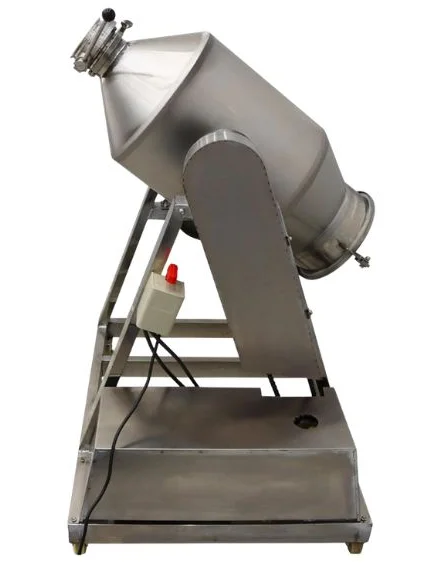
A tumble mixer is a diffusion mixer in which a partially filled vessel rotates around its horizontal axis. As the vessel turns, material is lifted by friction against the wall and then cascades back through the material bed. The mixing action is gentle and mechanically simple. There are no internal agitators in the product zone, which can be useful for fragile materials and simple blends.
Tumble mixer advantages
Tumble mixers are simple, enclosed and relatively easy to maintain. Because there are no internal moving parts in contact with the product, there are fewer contact points that can damage fragile particles or retain material. They can be effective for non-segregative blends with similar particle size, shape and bulk density. The gentle tumbling action can produce an acceptable blend without significant shear input.
Tumble mixer limitations
Tumble mixers are less suitable for segregation-sensitive blends. When ingredients differ significantly in particle size or density, mixing quality may reach a limit and then decline if the batch is mixed for too long. Process integration can also be more complex. Because the vessel itself moves, the mixer usually needs to be disconnected or specially coupled during filling and discharge. This can complicate containment, automation and integration with upstream or downstream equipment. Rotational speed is a critical process variable. If the speed is too low, mixing may be inefficient. If it is too high, material may not cascade properly, reducing mixing performance and increasing the risk of an unmixed batch.
Comparing low-shear batch mixer types
For simple, non-segregative blends, a tumble mixer may provide an economical and gentle solution. It is best suited to free-flowing materials with limited differences in particle size, density or flow behaviour.
For gentle convective mixing, efficient discharge and larger batch volumes, a conical screw mixer is often a strong option. It is particularly relevant where product protection, low energy input and controlled discharge are important.
For applications that need more active convective movement, a ribbon mixer may be suitable. It can be useful when ingredients differ in particle size or bulk density, but discharge design and seal arrangement require careful attention.
In practice, mixer selection should not be based on mixer type alone. The most suitable option depends on how the material behaves during filling, mixing, discharge and downstream handling.
Practical selection criteria
When selecting a low-shear batch mixer, evaluate the following process factors:
- flowability and angle of repose
- particle size distribution
- particle shape and aspect ratio
- bulk density differences between ingredients
- moisture content
- friability or particle fragility
- segregation tendency
- required mixing time
- batch size and filling level
- discharge behaviour
- cleanability and product changeover
- integration with upstream and downstream equipment
- available installation height and footprint
These factors should be evaluated together. A mixer that performs well during mixing may still be unsuitable if it creates discharge problems, retains product or encourages segregation during transfer.
Process testing and mixer selection
Mixer selection for low-shear batch mixing is best validated with representative material. Testing can help assess blend uniformity, segregation behaviour, filling degree, discharge characteristics, cleaning requirements and sensitivity to shear.
The results provide a practical basis for equipment selection, process configuration and scale-up. For segregation-sensitive materials, testing should also consider filling, discharge and downstream handling, as blend quality may change after leaving the mixer.
Learn more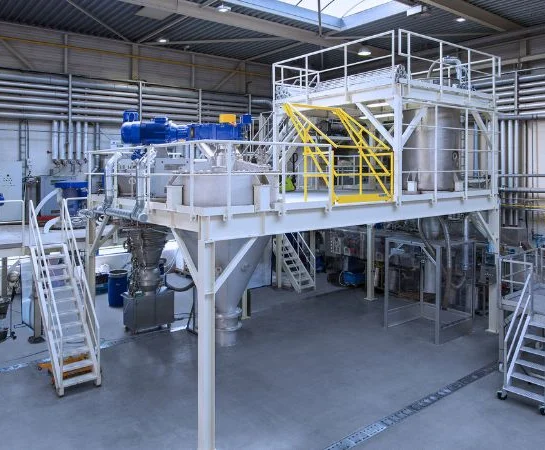
Talk to our experts
Evaluate material behaviour, mixer selection and process configuration for low-shear batch mixing of powders and bulk solids.

Related mixing technologies
FAQ – selecting a low-shear batch mixer
What is low-shear batch mixing?
Which materials are suitable for low-shear mixing?
Low-shear mixing is generally suitable for free-flowing powders with low cohesiveness, limited moisture content and predictable flow behaviour. Fragile or shear-sensitive particles may also benefit from gentle mixing.
When should a conical screw mixer be considered?
A conical screw mixer is often considered when gentle convective mixing, efficient discharge and low product degradation are important. It can be suitable for free-flowing, fragile or segregation-sensitive powders.
When is a ribbon mixer suitable?
A ribbon mixer can be suitable when a free-flowing blend requires more active convective movement than a tumble mixer can provide. It may be useful for ingredients with differences in particle size or bulk density, provided discharge behaviour and seal design are properly evaluated.
When is a tumble mixer suitable?
A tumble mixer is suitable for simple, non-segregative blends where gentle diffusion mixing is sufficient. It is less suitable for blends with large differences in particle size or bulk density.
What causes segregation in low-shear batch mixing?
Segregation can occur when particles differ in size, density, shape or mobility. It may happen during filling, vibration, mixing, discharge, transfer or packaging.
Can low-shear mixing be used for cohesive powders?
Cohesive powders usually require more mixing energy than free-flowing powders. Low-shear mixing may be possible when cohesion is limited or when additional mixing tools are used, but mid-shear or high-shear mixing is often more suitable for de-agglomeration or intensive dispersion.
Sustainable process technologies
Hosokawa Micron B.V. is committed to sustainable and responsible process technology. Our environmental management system is certified to ISO 14001, while our EcoVadis Silver Medal places us among the top 3% of rated companies in the special-purpose machinery industry.
