Batch mixing processes a defined quantity of ingredients for a set mixing time before discharge. Continuous mixing feeds and discharges material simultaneously, making stable dosing, residence time and process control more important.

Menu

KNOWLEDGE HUB
Process technologies for tomorrow.
Batch vs Continuous Powder Mixing
Process powders efficiently by selecting a mixing concept that matches the required throughput, product behaviour, formulation flexibility and level of process control. Batch and continuous powder mixing can both deliver consistent blends, but they differ significantly in residence time, dosing strategy, equipment configuration and integration with upstream and downstream unit operations.
Select the process according to the powder properties and production requirements rather than throughput alone. Hosokawa Micron provides batch and continuous powder mixing technologies ranging from low-shear conical screw mixers to high-shear batch mixers and compact continuous systems for powder-liquid addition, coating, agglomeration and controlled continuous blending.
Batch mixing is generally preferred for flexible recipes and frequent changeovers, while continuous mixing is better suited to stable formulations, sustained throughput and integrated continuous processing.
What is the difference between batch and continuous powder mixing?
 In a batch mixing process, a defined quantity of ingredients is charged into the mixer, processed for a specified time and discharged before the next batch begins. This approach provides clear separation between production lots and allows mixing conditions to be adjusted between batches.
In a continuous mixing process, powders and, where required, liquids are metered continuously into the mixer while mixed product is discharged simultaneously. Product quality therefore depends not only on the mixer itself, but also on accurate and stable feeding, residence time distribution and the interaction between the mixer and the surrounding process.
The choice between the two is consequently a system-level decision involving product properties, shear requirements, throughput, changeover frequency, dosing accuracy and downstream processing.
When is batch powder mixing appropriate?
Batch mixing offers a high degree of flexibility when recipes, batch sizes or process conditions change regularly. It is also well suited to applications where individual batches must remain clearly identifiable or where additional process steps need to be performed in the same vessel.
Hosokawa Micron’s batch mixing portfolio covers low-, medium- and high-shear processing. The Nauta® conical screw mixer by Hosokawa Micron provides low-intensity mixing for free-flowing, fragile and segregative powders, while the Hosokawa conical paddle mixer (CPM) provides low- to medium-shear mixing where shorter mixing times and limited product distortion are required. For cohesive powders or processes requiring greater energy input, the Cyclomix high-shear impact mixer by Hosokawa Micron combines shear and impact forces.
Batch processing can also be advantageous when the mixer performs several unit operations. Depending on the equipment configuration, mixing may be combined with liquid addition, coating, heating, cooling, reaction or vacuum drying.
Typical reasons to select batch mixing include:
- frequent recipe or product changes
- variable production quantities
- clear batch traceability
- processing of fragile or segregation-sensitive powders
- addition of liquids, oils or fats
- multi-purpose processing in a single vessel
- production campaigns requiring cleaning between products
When is continuous powder mixing appropriate?
Continuous powder mixing becomes particularly attractive when production runs are long, throughput is stable and the formulation can be supplied by accurately controlled feeders.
Because the mixer processes only a relatively small quantity of material at any given moment, continuous systems can combine high throughput with a compact equipment footprint and short residence times. Hosokawa’s continuous technologies include the Flexomix high-impact mixer by Hosokawa Micron and the Modulomix modular paddle mixer by Hosokawa Micron.
The Flexomix is designed for continuous high-intensity mixing of free-flowing or cohesive powders with liquids. It is also applied in processes such as coating and agglomeration. In cocoa processing, for example, Hosokawa uses the Flexomix for continuous lecithinising, where powder and liquid are mixed within a very short residence time.
The Modulomix is based on Hosokawa’s Cyclomix mixing principle and can be configured for low-, medium- or high-shear operation. It was developed particularly for continuous pharmaceutical processing and can be integrated with Process Analytical Technology for in-line monitoring of blend quality.
Typical reasons to consider continuous mixing include:
- high or sustained production throughput
- stable recipes and feed conditions
- short required residence time
- limited available floor space
- direct integration with continuous upstream or downstream processing
- continuous powder-liquid addition
- automated process control and in-line quality monitoring
Throughput is not the only selection criterion
High production volume does not automatically require continuous mixing. Large-volume batch mixers can provide high throughput where long campaigns, gentle processing or flexible batch sizes are required. Alternatively, smaller high-intensity batch mixers can achieve high overall production rates through short mixing cycles. Continuous mixing becomes more attractive where a compact installation, stable feed conditions and uninterrupted process flow are priorities.
The required production rate should therefore be assessed together with cycle time, mixer working volume, filling and discharge time, cleaning requirements and upstream dosing capacity.
Shear and mixing energy
The required mixing intensity is another fundamental selection parameter.
Low-shear processing is generally preferred when the objective is homogenisation with limited particle damage. Higher shear or impact may be required when powders are cohesive, liquids need to be dispersed through the powder bed or the process includes coating, deagglomeration or agglomeration.
Hosokawa Micron therefore separates both batch and continuous technologies according to mixing intensity rather than treating batch and continuous processing as two fixed technologies.
For batch processing, mixing energy can often be adjusted through rotor or screw speed and mixing time. In a continuous process, the mixing intensity must additionally be considered in combination with feed rate and residence time.
Dosing accuracy is critical in continuous mixing
A continuous mixer can only produce a consistent formulation if the incoming mass flows remain stable.
Powders and other bulk solids are therefore commonly supplied using controlled feeding systems, while liquid addition requires similarly accurate flow control. Hosokawa’s continuous agglomeration systems, for example, use loss-in-weight powder feeding in combination with controlled liquid dosing to maintain a constant powder-to-liquid ratio.
This makes feeder performance, refill strategy and process controls integral parts of the continuous mixing system rather than ancillary equipment.
Batch mixing is less dependent on instantaneous feed stability because the complete formulation can be weighed before or during charging. Nevertheless, weighing and dosing accuracy remain important for final blend quality.
Residence time and process control
Residence time is fundamentally different in the two process concepts.
A batch mixer exposes the complete batch to the mixing process for a defined period. Process adjustments therefore influence the entire batch.
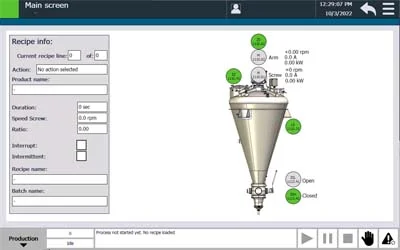
In continuous mixing, each element of powder passes through the equipment during a relatively short residence period. Mixer geometry, rotational speed and feed rate influence both mixing intensity and residence time distribution. The process must also account for start-up, shutdown and process disturbances.
Hosokawa’s Modulomix was developed with this in mind, including fast response, low internal residue and rapid start-up and shutdown behaviour. For pharmaceutical applications, in-line analytical devices can be integrated to continuously monitor the process.
Product changeover and cleaning
Where a production line handles many formulations, cleaning and product changeover can strongly influence overall plant utilisation.
Batch systems provide a natural break between production lots. This can simplify inspection, sampling and cleaning, particularly where operators need direct access to the mixing vessel.
Continuous processing eliminates repeated filling and discharge cycles during long campaigns, but product changeover must be considered during system design. Residual material in feeders, transfer lines and the mixer must be managed together, particularly where cross-contamination is critical.
The correct comparison should therefore consider the entire mixing line rather than mixer cleaning alone.
Batch versus continuous mixing at a glance
| Process consideration | Batch mixing | Continuous mixing |
|---|---|---|
| Recipe flexibility | High | Best with relatively stable formulations |
| Production quantity | Small to very large batches | Sustained continuous throughput |
| Product traceability | Naturally batch-defined | Requires defined continuous production strategy |
| Residence time | Defined mixing cycle | Short, distribution-dependent |
| Dosing | Ingredients charged per batch | Continuous, stable mass-flow control essential |
| Changeover | Well suited to frequent changes | Most efficient during longer campaigns |
| Footprint | Depends on batch volume | Can be compact for high throughput |
| Process integration | Flexible stand-alone or multi-purpose vessel | Particularly suitable for continuous lines |
| Process monitoring | Batch sampling and controls | Can support continuous in-line monitoring |
| Shear range | Low to high | Low to high, depending on technology |
Selecting the mixer as part of the complete process
Mixer selection should start with the powders and liquids being processed. Relevant parameters include flowability, cohesiveness, bulk density, particle size distribution, segregation tendency, fragility, liquid addition and the required mixing energy. Hosokawa also considers factors such as operating pressure and the risk of cross-contamination when selecting and configuring the mixer.
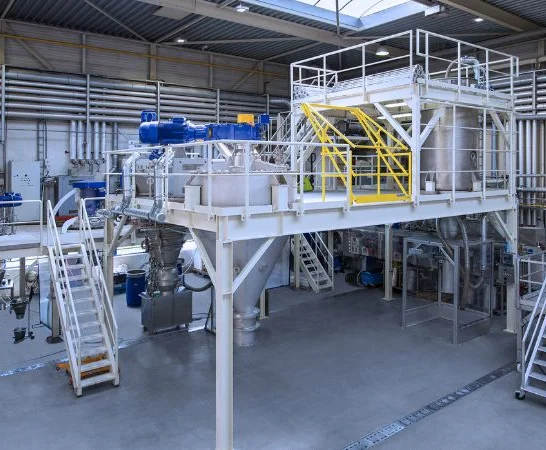
The surrounding process is equally important. Storage, weighing, dosing and conveying of powders and bulk solids, together with discharge, sampling and downstream equipment, can determine whether batch or continuous operation provides the most robust overall solution.
Hosokawa Micron therefore develops powder mixing systems as integrated processing solutions rather than treating the mixer as an isolated machine.
Powder and solids handling, process automation and other unit operations can be incorporated into the system design.
Testing batch and continuous mixing processes
The behaviour of powders and other bulk solids is difficult to predict solely from material data. Testing is therefore valuable when comparing mixer types, determining mixing energy or transferring a process from laboratory to industrial scale.
Hosokawa Micron operates testing and process development facilities in Doetinchem, the Netherlands, with equipment for both batch and continuous mixing. Trials can be used to evaluate process feasibility, product quality and scale-up before final equipment or system design.
The appropriate choice between batch and continuous powder mixing ultimately depends on the interaction between material behaviour, production strategy and process integration. Evaluating these factors together provides a more reliable basis for mixer selection than throughput or mixer type alone.
Frequently asked questions (FAQ)
What is the main difference between batch and continuous powder mixing?
Is continuous mixing always better for high throughput?
No. Large-volume batch mixers can also achieve high production rates, particularly where gentle processing, flexible batch sizes or campaign production are required. Continuous mixing becomes more attractive where stable feed conditions, compact equipment and uninterrupted process flow are priorities.
Which mixing process is better for frequent product changeovers?
Batch mixing is generally better suited to frequent product or recipe changes because each batch provides a natural separation point for discharge, inspection and cleaning. Continuous systems are typically most efficient during longer production campaigns.
Why is dosing accuracy important in continuous powder mixing?
In continuous mixing, final blend quality depends on maintaining stable mass flow from all powder and liquid feeders. Variations in feed rate can immediately influence formulation ratio and product consistency, making dosing and process control integral parts of the mixing system.
Can both batch and continuous mixers handle different shear requirements?
Yes. Both batch and continuous powder mixing technologies can be configured for low-, medium- or high-shear processing. The required mixing intensity depends on powder flow behaviour, cohesiveness, fragility, liquid addition and the desired process result.
Talk to our experts
Let our process specialists help you identify the most suitable solution for your materials, process requirements and production goals.

Read more


Sustainable process technologies
Hosokawa Micron B.V. is committed to sustainable and responsible process technology. Our environmental management system is certified to ISO 14001, while our EcoVadis Silver Medal places us among the top 3% of rated companies in the special-purpose machinery industry.
